
Blog, Emergency Tree Care
Why Professional Tree Work Is More Complicated Than It Looks
From the ground, tree removal can look pretty straightforward.
Cut the tree. Let it fall. Clean up the mess.
If only it were that simple.
In reality, professional tree service involves considerably more planning, knowledge, equipment, and safety considerations than most homeowners realize. Every tree is different, and removing a tree safely requires understanding not only the tree itself, but everything around it.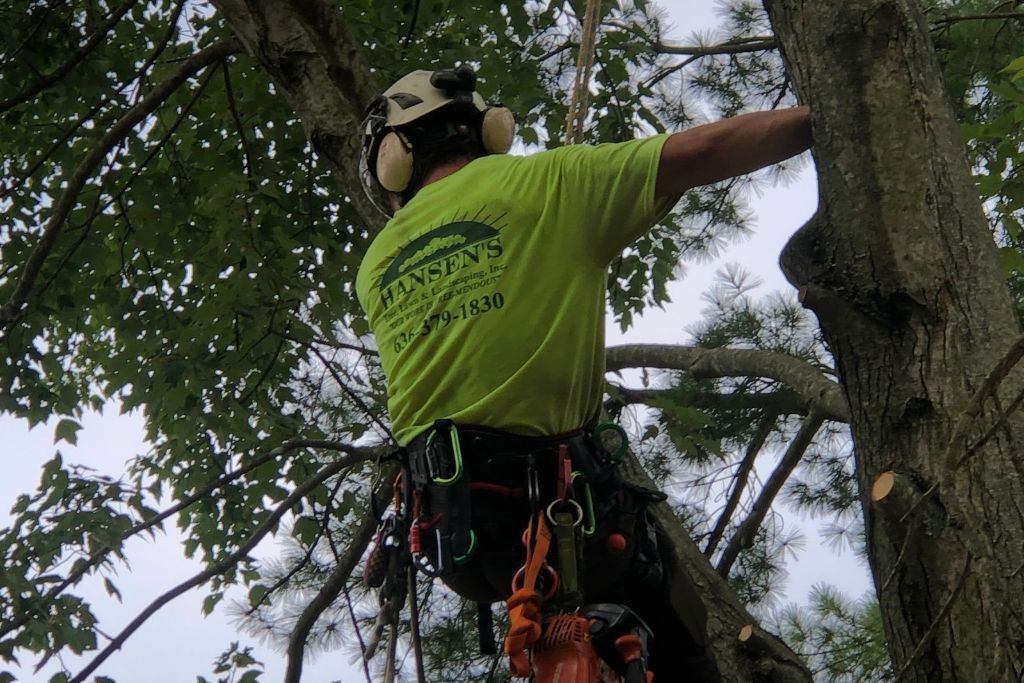
Where is the tree leaning? How large are the branches? Where will they fall? Are there power lines nearby? Is the tree already damaged or weakened by decay?
And perhaps the most important question: What happens if the tree doesn’t do what you expect it to do?
Trees Don’t Always Fall Where You Want Them To
One of the biggest misconceptions about tree removal is that a tree can simply be cut at the base and directed toward an open area.
Sometimes that works.
Sometimes there’s a house, garage, fence, vehicle, utility line, or another tree sitting exactly where you don’t want several thousand pounds of wood to land.
The natural lean of a tree, its branch distribution, trunk structure, wind conditions, and surrounding obstacles all have to be considered before work begins.
Professional tree crews may use ropes, rigging systems, specialized equipment, and carefully planned cutting techniques to control how branches and sections of the tree are removed.
It’s not just about getting the tree down.
It’s about planning and controlling what happens while it’s coming down.
Tree Removal Safety Starts with an Assessment
Before any cutting begins, professionals need to evaluate the tree and the work area.
That assessment may include looking for dead branches, cracks, cavities, decay, previous storm damage, unusual growth patterns, and other structural concerns. The surrounding property and other factors also need to be considered.
- Are there structures within the potential fall zone?
- Are there overhead utility lines?
- Can equipment safely access the site?
- Where will branches and sections of trunk be lowered?
- What will happen if weather conditions change?
These aren’t theoretical questions.
They’re part of determining how the work can be performed safely.
A Damaged Tree Can Be Even More Complicated
Storm-damaged trees present their own challenges.
A tree that has lost a major limb or partially failed may have significant tension and weight distribution changes. Broken branches can become suspended overhead, while cracks and splits may make the tree’s remaining structure unpredictable.
This is one reason homeowners should be especially cautious about attempting to remove storm-damaged trees themselves, because:
- A branch that appears to be resting harmlessly may be under tremendous tension.
- A trunk that appears stable may shift once another section is cut.
- And a damaged tree can behave very differently from a healthy, standing tree.
When a tree has already failed once, don’t assume the rest of it is going to cooperate.
The Equipment Makes a Difference
Professional tree work often requires equipment that isn’t sitting in the average homeowner’s garage.
Depending on the job, crews may use bucket trucks, chippers, chainsaws, stump grinders, ropes, rigging equipment, loaders, and other specialized tools.
But having the equipment isn’t enough. It has to be used correctly.
Tree removal often involves working at height, managing heavy loads, operating powerful equipment, and coordinating multiple people on the ground and in the tree.
That’s a very different proposition from trimming a small branch with a hand saw.
What About Trees Near Power Lines?
Trees growing near utility lines require particular caution.
Branches and trunks can conduct electricity, and even approaching or cutting vegetation near energized lines can create serious hazards.
Homeowners should never assume that a line is safe to work around simply because it doesn’t appear to be carrying electricity.
When trees and utility lines are involved, the appropriate professionals should be contacted to determine how the work can be performed safely.
Sometimes the safest approach is not the most obvious one.
Professional Tree Work Is About More Than Removal
It’s also important to remember that tree service doesn’t necessarily mean tree removal.
Professional tree care can include pruning, tree health assessments, storm-damage evaluation, disease and pest management, structural evaluation, and other services designed to maintain healthy and structurally sound trees.
In some situations, appropriate care may allow a valuable tree to remain on the property. In others, removal may ultimately be the safest or most appropriate option.
The job is figuring out which situation you’re dealing with.
When in Doubt, Call a Professional
There are certainly small tree-care projects many homeowners can handle themselves.
But when a job involves large branches, mature trees, climbing, power lines, significant structural defects, storm damage, or trees close to buildings and other valuable property, professional help isn’t simply about convenience.
It’s about managing risk.
At Hansen’s Tree Service, our experienced tree-care professionals can evaluate your trees, identify potential hazards, and determine the appropriate approach for pruning, removal, or other tree-care needs. Contact us today!